Tuesday, April 19, 2011

Gasoline Coupons

Overlooked Gas Coupons


I  didn't realize it, but these coupons are good for one  gallon of gas at most retailers.

I have seen them around, but until  recently never took advantage of them, I never realized  their actual worth.

You  probably have one or two just lying around somewhere.

Now is the time to use them before  they lose their value, and it's too  late!!


 SEE  COUPON BELOW...
 

......
......
......
......
......
......
......
......
......


Friday, April 15, 2011

Hong Kong Debuts its First 3D Erotic Film
d0c3eb8ca18907492a4b337b5cec5193.jpeg

r3763111861.jpg
Reuters – Japanese adult actress Saori Hara is interviewed during the making of "3D Sex and Zen" at a …

By Stefanie McIntyre and James Pomfret – Thu Apr 14, 2:17 pm ET
HONG KONG (Reuters) – A period drama about a young man, a duke and royal orgies drew hundreds in Hong Kong to the premiere of the territory's first 3D erotic film earlier this week.

The soft-porn "Sex & Zen: Extreme Ecstasy" debuts as the stricken porn industry turns to 3D as a potential money-spinner to revive its fortunes following the success of Hollywood blockbusters such as "Avatar."

"What we're going to expect is that people don't take it as an erotic or any gross thing to look at," said director Christopher Sun.

"Try to take it as an entertaining movie for adults."

His father, Stephen Shiu, was responsible for the original "Sex and Zen," a 1991 film that grossed over US$2.6 million and held the crown as the city's highest-grossing adult film for over a decade.

Friday, March 18, 2011

Taming Chaos with a Personal Plan | STRATFOR

Taming Chaos with a Personal Plan | STRATFOR

Taming Chaos with a Personal Plan
March 16, 2011 | 1805 GMT
By Scott Stewart
Over the past week we’ve seen a massive earthquake and tsunami in Japan that caused a nuclear accident, the Saudis sending troops into Bahrain to quell civil unrest there and the government of Yemen taking measures to expel foreign media as protests have swelled against Yemeni President Ali Abdullah Saleh.
We have also recently seen large-scale evacuations of expatriates from Tunisia, Egypt and Libya, and it is not unreasonable to assume that we might see a similar exodus from Bahrain and Yemen if developments in those countries deteriorate. Moreover, in Japan, the risk of radiation and conditions that are not yet under control at the Fukushima Daiichi nuclear power plant could force further evacuations there.
In light of this uncertain environment, STRATFOR thought it prudent to address once again the topic of personal contingency planning. Indeed, we also made this topic the subject of this week’s playbuttonsmall.gif Above the Tearline video. While we have often discussed this topic in relation to terrorist attacks, its principles are also readily applicable to crises caused by natural disaster, war and civil unrest. When a crisis erupts, having an established personal contingency plan provides people with a head start and a set of tools that can help them avoid, or at least mitigate, the effects of the chaos and panic that accompany crisis events.
When Chaos Reigns
When a crisis erupts due to civil unrest, natural disaster or a major terrorist attack, a number of things happen rapidly and sometimes simultaneously. First, panic ensues as people attempt to flee the immediate scene of the disaster, usually seeking safety using the same escape routes. At the same time, police, fire and emergency medical units all attempt to respond to the scene, so there can be terrible traffic and pedestrian crowd-control problems. In the event of large civil disturbances, roads can also be clogged with protesters, troops and panicked civilians. This can be magnified by smoke and fire, which can reduce visibility, affect breathing and increase panic.
In many instances, an attack or natural disaster will cause damage to electrical lines, or the electricity will be cut off as a precautionary measure. Natural gas, water and sewer lines can be damaged, causing leaks, and in the case of natural gas lines raising the threat of explosions and fire. 
Earthquakes and mudslides can cut roads and shut down mass transit. Often, people find themselves trapped in subway tunnels or in high-rise buildings, and they are sometimes forced to escape through smoke-filled tunnels or stairwells. Depending on the incident, bridges, tunnels, subway lines and airports can be closed or jammed to a standstill. Grocery stores are frequently inundated by people scrambling (and sometimes fighting) to obtain food and supplies.
In the midst of this confusion and panic, telephone and cell-phone usage soars. Even if the main trunk lines and cell towers are not damaged by the event or otherwise affected by the loss of electricity, this huge spike in activity quickly overloads the exchanges and cell networks. This means the ripples of chaos and disruption roll outward from the scene of the crisis as people outside the immediate vicinity of the crisis zone hear about the situation via the media and wonder what has become of loved ones who were in or near the crisis zone.
The Need to Plan
Those caught in close proximity to such a disaster site have the best chance of escaping and reconnecting with loved ones if they have a personal contingency plan. While such planning is critically important for people who live and work overseas in high-threat locations, recent events have demonstrated that even people residing in places considered safe, like Cairo and Tokyo, can be caught in the vortex of a crisis. Taking this one step further, sudden disasters, such as tornadoes, earthquakes, school shootings or the derailment of train cars carrying chlorine, can strike almost anywhere. This means that everyone should have a personal contingency plan.
Emergency plans are vital not only for corporations and for schools but also for families and individuals. Such plans should be in place for each regular location — home, work and school — that an individual frequents and should cover what that person will do and where he or she will go should an evacuation be necessary. This means establishing meeting points for family members who might be split up — and backup points in case the first or second point also is affected by the disaster.
When school-aged children are involved, parents need to take the time to coordinate with the school to learn what the school’s crisis plans are so any measures the school employs can be accounted for during the planning process. A crisis plan should also account for any pets a family may have.
The lack of ability to communicate with loved ones because of circuit overload or other phone-service problems can greatly enhance the sense of panic during a crisis — especially in this age, when people are so dependent on almost-constant communications via the ubiquitous smart phone. 
Perhaps one of the foremost benefits of having personal and family contingency plans in place is the reduction of stress that results from not being able to contact a loved one immediately. Knowing that everyone is following the plan frees each person to concentrate on the more pressing challenges presented by their personal evacuation. This is critical because someone who waits until he or she has contacted all loved ones before evacuating might not make it out.
It also is important to have a communications plan, which should include the contact information for the designated rallying site as well as an alternate communications hub outside of the area. It might be difficult to communicate from point A to point B, but someone at point A or B might be able to get through to a person at point C. For example, it may be impossible to call from Tripoli to New York, but both parties may be able to call through to Rome.
Alternative means of communication also should be included in the communications plan. If the phone lines and cell phones are clogged, many times text messages can still get through and Internet connections may work to send e-mail. Satellite telephones, though expensive, are also very useful in a communications blackout, as are two-way radios. Analog fax lines can also prove useful when other forms of communication are shut down.
People who are going to serve as communications hubs need to be briefed on the evacuation plan and have contact information (landline and cell phone numbers, e-mail addresses, etc.) for each person who will be participating in the evacuation. The communications hub should also be provided with important personal data on each person, including full name, date of birth, passport numbers, etc. The communications plan also will be helpful in case one member of the family is unable to evacuate immediately or finds it unwise to evacuate at all. In that case, he or she will know where the rest of the family is going and how to contact them once communications are restored.
Planning is important because, when confronted with a dire situation, many people simply do not know what to do or where to start. It is not unusual to find people wandering aimlessly at the scene of a disaster. Not having determined their options in advance — and in state of shock over the events of the day — people quite often find themselves unable to think clearly enough to establish a logical plan, so they just drift around or collapse in helplessness. Having a plan in place gives even a person who is in shock or denial and unable to think clearly a framework to lean on and a path to follow.
Evacuating
One of the keys to surviving a catastrophe is situational awareness. Situational awareness allows people to recognize a potential threat at an early stage and take measures to avoid it. Situational awareness also helps people know where to go when an unforeseen disaster strikes. For example, if the airport is closed by the crisis, situational awareness enables one to understand the alternate means of leaving the country, and if a bridge is damaged on an alternative land route, you can locate another way out. Being aware of the layouts of your residence and workplace is also critical. If an office building is hit by an incident of workplace violence or catches fire, people with a plan will know where the fire exits are and where they lead. Situational awareness will then help them realize when an exit could lead them out of the frying pan and into the fire.
Situational awareness also aids in reacting to a dangerous situation while on the move. If a subway tunnel is filling with smoke from a fire or bombing, situational awareness tells one to keep low in order to avoid being overcome by smoke. Better still, proper preparation can lead people to carry important items such as a smoke hood that can be worn to protect against smoke and a flashlight to help navigate a dark place like a tunnel.
For individuals who work in high-rise buildings, frequently travel or routinely take a commuter train or subway, these two items can greatly assist you if the need to evacuate arises. Smoke hoods are relatively inexpensive devices that can be carried in a briefcase or purse and quickly donned in case of emergency. They will usually provide around 20 to 30 minutes of breathing time, which could quite literally mean the difference between life and death in a smoke-filled hallway, stairway or subway tunnel. Likewise, a small flashlight could prove to be invaluable in a crisis situation at night or when the power goes out in a large building or subway. Some of the small aluminum flashlights can also double as a handy self-defense weapon.
Of course, in some situations, evacuation might not be the best idea. If there is no immediate threat at a specific location, it may be more dangerous to join a crowd of panicked people on the street. In some cases, it might be safest to just stay in place and wait for order to return — especially if the shelter is stocked with food, water and other basic necessities. Situational awareness will allow you to make the call on whether to stay or go.
As part of a contingency plan, it is also prudent to prepare a small “fly-away” kit containing clothes, water, a first-aid kit, nutritional bars, medications and toiletry items for each member of the family. It also is a good idea to include a battery-powered or crank-powered radio and other items such as appropriate maps, multi-tool knives and duct tape. An appropriate amount of cash can also prove quite useful. The kit should be kept in a convenient place, ready to grab on the way out. Even if it is impractical to keep all these items in constant readiness, keeping most of them together and using a prepared list to collect the other items quickly can help get one out the door in seconds. Maintaining important papers, such as vehicle titles, deeds, licenses, birth certificates, passports and credit card information, in a central file allows it to be quickly retrieved in case of an evacuation. Of course, passports are of vital importance in an overseas situation.
Another important part of situational awareness is having the means to receive instructions and information from the authorities. In addition to radio and television, many locations have emergency text and e-mail alert systems that can provide critical information. Overseas, embassies also maintain networks for disseminating information to expatriates such as the U.S. Department of State’s warden system. Individuals should register for such services and ensure they know how information is disseminated before the crisis hits and results in communication disruptions.
When it comes to information pertaining to emergency plans and fly-away kits, the U.S. Federal Emergency Management Administration’s ready.gov site is an excellent resource. For people residing overseas, the U.S. Department of State’s travel information site and the Overseas Security Advisory Council are also valuable resources filled with helpful information.
Now, while it is important to listen to authorities in the case of an emergency, individuals cannot rely on the government to take care of them in every situation because the resources simply may not be available. This means that individuals must have a plan in place designed to take care of themselves and their families.
Flexibility Required
In order to be effective, an emergency plan must be fluid and flexible. It is important to recognize that even a good plan can be worthless if reactive measures taken by authorities during an emergency impede execution of the plan, or if the catastrophe itself closes down the airport or a section of a primary escape route. For these reasons, it is best to have several alternate contingency plans that account for multiple scenarios and include various routes and modes of evacuation. Once the emergency is announced, it likely is too late to start devising a back-up plan.
Plans must be also reviewed periodically, at least once a year. A plan made following 9/11 might no longer be valid. Bridges and roads included in the original plan might be closed for construction at the present time or could have been changed to a one-way traffic pattern. Communication plans may also need to be updated if family members move or change telephone numbers.
The contents of fly-away kits should be checked periodically to ensure the kits are functional. Flashlight and radio batteries can lose their charge and need to be replaced. Items such as smoke hoods can become damaged by being carried around in a purse or briefcase for too many years. Food can become stale and inedible. Medications can expire. Children can grow and require different sizes of clothing.
Finally, while having a contingency plan on paper is better than having nothing, those plans that are tested in the real world prove to be far superior to plans that are never tested. Running through an evacuation plan (especially during a high-traffic time such as rush hour) will help to identify weaknesses that will not appear on paper. It also will help ensure that all those involved know what they are supposed to do and where they are supposed to go. A plan is of limited use if half of the people it is designed for do not understand their respective roles and responsibilities.
No plan is perfect, and chances are that individuals will find themselves “shifting on the fly” as conditions on the ground change in the event of an actual emergency. However, having a plan and being prepared allows a person to be more focused and less panicked and confused than those who have left their fate to chance.
Reprinting or republication of this report on websites is authorized by prominently displaying the following sentence, including the hyperlink to STRATFOR, at the beginning or end of the report.
"Taming Chaos with a Personal Plan is republished with permission of STRATFOR."


    Wednesday, February 02, 2011

    Get Internet Access When Your Government Shuts It Down

    Here is an important set of tools for anyone living is an area where the government shuts down internet service.


    As world wide web users, you already know how much you use the internet for all manner of functions. 


    Some of these methods were used in Egypt. If you have friends in volatile areas pass this on.


    http://www.pcworld.com/article/218155/get_internet_access_when_your_government_shuts_it_down.html

    Friday, January 21, 2011

    The Lady That Fell Into a Fountain While Texting


    Make the World Safe for Texters!


    On ABC’s “Good Morning America” this morning, George Stephanopoulos spoke to the woman who fell into a mall fountain while she was texting. Accompanied by her attorney, she said she intends to hold all guilty parties responsible.

     Turns out that at the time this woman did her face-plant, she was under investigation for charging $5,000 on a coworker's credit card. Dunk her again!

    Wednesday, March 24, 2010

    So You Like Flying?

    Up In The Air Or Not

    *************************************

    Continental Airlines
    Continental Airlines has become the last of the big U.S. carriers to offer free meals for coach passengers.

    *************************************


    *************************************

    Airline Announcements
    United Flight Attendant announced, 'People, people we're not picking out furniture here, find a seat and get in it!

    *************************************

    On landing, the stewardess said, 'Please be sure to take all of your belongings. If you're going to leave anything, please make sure it's something we'd like to have.

    *************************************

    'There may be 50 ways to leave your lover, but there are only 4 ways out of this airplane'

    *************************************

    Another flight attendant's comment on a less than perfect landing: 'We ask you to please remain seated as Captain Kangaroo bounces us to the terminal.'

    *************************************

    *************************************


    *************************************

    An airline pilot wrote that on this particular flight he had hammered his ship into the runway really hard. The airline had a policy which required the first officer to stand at the door while the passengers exited, smile, and give them a 'Thanks for flying our airline.

    ' He said that, in light of his bad landing, he had a hard time looking the passengers in the eye, thinking that someone would have a smart comment.

    Finally everyone had gotten off except for a little old lady walking with a cane.


    She said, 'Sir, do you mind if I ask you a question?'
    'Why, no, Ma'am,' said the pilot. 'What is it?' The little old lady said, 'Did we land, or were we shot down?'


    *************************************

    As the plane landed and was coming to a stop at Ronald Reagan, a lone voice came over the loudspeaker: 'Whoa, big fella, WHOA!'

    *******************************************


    *******************************************

    After a particularly rough landing during thunderstorms in Memphis, a flight attendant on a Northwest flight announced, 'Please take care when opening the overhead compartments because sure as hell everything has shifted after a landing like that.'

    *******************************************


    *******************************************


    *******************************************

    Overheard on an American Airlines flight into Amarillo , Texas on a particularly windy and bumpy day: During the final approach, the Captain was really having to fight it.
    After an extremely hard landing, the Flight Attendant said, 'Ladies and Gentlemen, welcome to Amarillo . Please remain in your seats with your seat belts fastened while the Captain taxis what's left of our airplane to the gate!'

    ***********************************

    'Your seat cushions can be used for flotation; and, in the event of an emergency water landing, please paddle to shore and take them with our compliments.'

    ***********************************


    ***********************************

    As you exit the plane, make sure to gather all of your belongings. Anything left behind will be distributed evenly among the flight attendants. Please do not leave children or spouses......except for that gentleman over there.'

    ***********************************

    After a real crusher of a landing in Phoenix , the attendant came on with, 'Ladies and Gentlemen, please remain in your seats until Capt. Crash and the Crew have brought the aircraft to a screeching halt against the gate.

    And, once the tire smoke has cleared and the warning bells are silenced, we'll open the door and you can pick your way through the wreckage to the terminal..'


    ***********************************


    The U.S. Department of Transportation’s Bureau of Transportation Statistics released the following air travel 2009 facts:
    *) 703.9 million travelers
    *) U.S. airlines flew 6.6% fewer domestic and international flights than in 2008
    *) U.S. flights were on average 80.4% full system wide
    *) Airlines expected to lose $2.8 billion in 2010.

    ***********************************


    ***********************************

    Part of a flight attendant's arrival announcement: 'We'd like to thank you folks for flying with us today. And, the next time you get the insane urge to go blasting through the skies in a pressurized metal tube, we hope you'll think of US Airways.'

    ***********************************

    Thursday, December 17, 2009

    Time-Shifted TV Shows Update


    The 11 most time-shifted TV shows, through Nov. 2009

    Source: Advertising Age

    PROGRAM# OF PEOPLE*
    1Fox's "House"5,038,000
    2ABC's "Grey's Anatomy"4,968,000
    3NBC's "The Office"3,810,000
    4CBS's "NCIS"3,588,000
    5CBS's "The Mentalist"3,577,000
    6ABC's "V"3,566,000
    7ABC's "Deperate Housewives"3,355,000
    8CBS's "The Big Bang Theory"3,219,000
    9CBS's "Survivor: Samoa"3,112,000
    10ABC's "FlashForward"3,098,000
    11CBS's "Criminal Minds"3,075,000


    Tuesday, November 17, 2009

    The Yankees Other Paper Parade

    The New York Yankees won the 2009 World Series in 4 out of 6 games, which was a minor sweep of the Philadelphia.

    On November 6, 2009 a Ticker Tape parade was thrown to honor their 27th World Series victory with speeches and award ceremonies at City Hall, but afterwards, like the end of any great party, there comes the clean-up.


    Cleaning up after a party is hard to do unless you are New York City.


    The parade and clean up cost about $340, 000 with most of that money donated from private sources.


    Found during the big clean-up parade of the confetti debris was some medical records, financial statements and court records.


    Some critics, who did not seem to live in New York City, said it would take weeks to clean up the paper. It was gone within hours.


    It was a great up-lift for a financially stressed city. And next year? Go Mets!

    Thursday, October 01, 2009

    Worst EPA Green Ad to Date

    Nothing Says Green, Clean and Radon Free
    Like Covering Your Stinky Feet With Green Socks.


    Tuesday, September 22, 2009

    Estelle Getty's Emmy Auctioned Off On eBay

    TV Academy Angry

    Variety reports the Academy of Television Arts & Sciences wants Estelle Getty’s 1987 Emmy for supporting comedy actress for her work in "The Golden Girls" removed from sale on eBay.

    The statuette is being offered by a seller of fine art, with an initial asking price of $15,000. As of Tuesday afternoon, Sept. 22, 2009, there were no bids.

    Friday, September 11, 2009

    THE WEEK WITHOUT A MONDAY 9/11

    A 9/11 retrospective, written on 9/17/01

    9/10-16/2001
    8 Blocks from Ground Zero
    Barbara Fultz Martinez

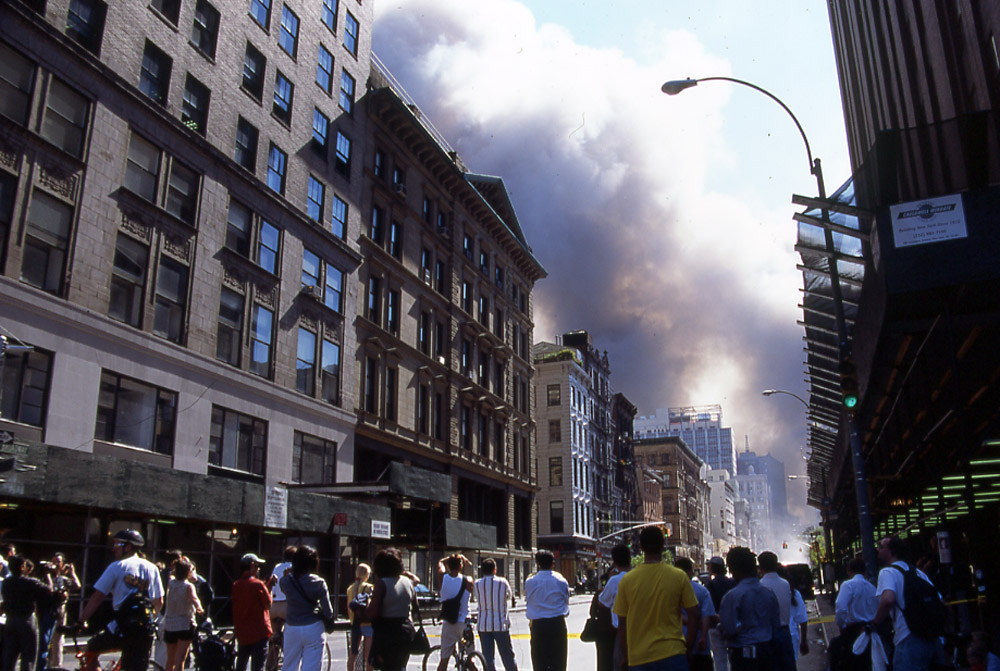
    People start things on Monday, set them going, especially in New York City in September when everyone is revving back into high gear. But Monday, September 10, 2001, is a lost day on the New York calendar.

    Again and again, this week you heard, "on Monday, ... the first plane... the second plane... on Monday, the first tower... the second tower... on Monday...the Pentagon...on Monday... 4 planes hijacked...on Monday...8 planes...on Monday..." Only it was Tuesday, the first day of this week, and the first day of tomorrow. People kept saying "on Monday..."


    We live 8 blocks from where the World Trade Center was. I always said "6 blocks"... when you live near something that big it seems very close. I had to count the blocks on the map on Sunday to be certain how many it really was. It was our back yard, over by the river, next to the parks and the Financial Center marina and Battery Park City, actually 3-4 blocks from our 4 schools and our Little League / Soccer League ball park.

    Tuesday, I was in my office in Long Island (the other side of Queens); Lionel was at the loft. We phoned back and forth many times. My nephews phoned and sent emails. I sent emails; he sent emails. We never lost touch. TV never stopped transmitting; radios never went silent. Subways never stopped entirely; they just lost their southern stops in Manhattan. Metro North and LIRR worked outbound till evening, then inbound came back. The LIRR started up inbound service to Penn Station at 5:00 pm.


    Power went out at 39 Worth in the afternoon when 7 WTC fell. Our ATT local and long distance service at home never failed.

    But without power, no answering machine.

    Tuesday I got to our nephew, Stephen's uptown apartment on West 56 Street by 6:30. No delays; no crowds at Penn Station. Subway north, no crowd, no delay. Rush hour. Empty somber streets. People had already moved themselves
    out.

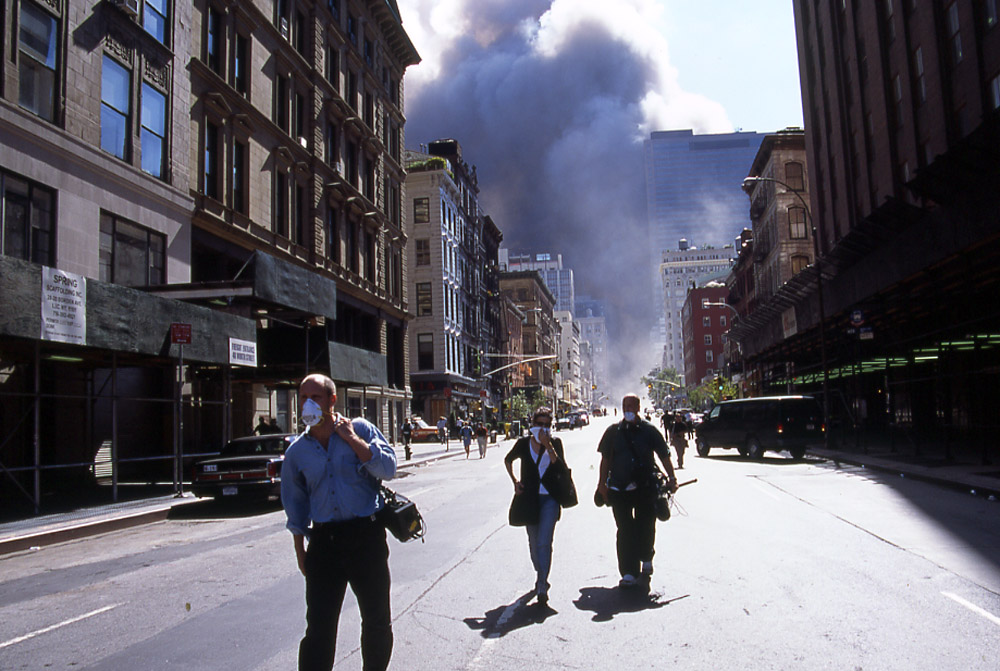
    Lionel fielded phone calls all afternoon at the loft, then hiked to 14th Street, with clothes and toothbrushes and a stock of face masks, and took the A train; he arrived about 9:30, shoulders sagging, somber. Stephen brought us a pizza. We didn't talk much. When I couldn't understand words spoken on TV anymore I fell into a daze. Steve didn't want to watch TV. Lionel stared at it.

    We slept at Steve's Wednesday and Thursday and went to work every day, like most New Yorkers who didn't have offices downtown but, like everybody, we didn't concentrate very well and kept wandering off to watch or listen to the news.

    The hand shape formed by the spines from the top of one of the towers resting on Church Street is burned into my memory like a memorial sculpture.

    All week, people kept saying we must not do to "them" what we did to the Japanese Americans in WWII. Then, "They"... at war against "them" whoever, wherever "they" are. On Sunday they said "the people on the front lines are diplomats & spies."

    We felt better when Rudy Giuliani came on TV; he made us feel like "us" in NY City; he did it magnificently simply and well. He was real in helping us express and surround our losses, our uniformed police and firemen and all those missing thousands who used to work every day in the Twin Towers, and, potentially, all those who poured in to help.


    The NYC Office of Emergency Management was awesome in deploying the
    rescue effort. It was not chaotic even if it was hectic and heroic in
    proportions. I had never imagined what my city had prepared for.

    Wednesday and Thursday the list grew of other buildings our neighborhood may lose, "stable" for the moment because they won't fall on the rescue workers but likely slated to be pulled out of the skyline too... the other WTC buildings, one a temporary morgue when it fell, the Millennium Hotel, the Marriott Hotel, and at least one of the big pinkish buildings with the sky-reflecting windows at the World Financial Center, several little buildings, Dave's Cookies.... You still cannot separate fact and rumor.

    It felt very personal: Our neighborhood's powerful, wonderful, flashy back yard over by the marina was irrevocably destroyed, a gaping smile in the waterfront skyline. In the words of a neighbor: "every time you turned the corner it was always there. You always looked up. You wanted to see what the weather would be." The towers were our weathervane. You could tell by how high or close the fog or mist or clouds clung whether things would dissipate or last for hours.

    We do live here, even if we couldn't say anything because what are buildings compared to thousands of lives? We were embarrassed to mourn architecture in the face of so much human tragedy, to mourn our neighborhood.

    With the collapse of 7 WTC on Tuesday and damage to Verizon, email transmissions from my office failed but I didn't know till the next day. Local ISPs like AIM's i-2000 lost routes through main regional servers, and access priority went to the feds, FEMA, CIA, FBI, National Guard anyway. The Cable & Wireless phone service from AIM got me regional NYC and Brooklyn numbers; but no incoming and no outgoing long distance. All was out all week. We didn't have to go back to the loft every night.


    My friend around the corner had electricity and phones and my keys; she fed Mozart and Homer every morning. But we did go back through the perimeter every night, hoping the power might come back.

    On Wednesday, Worth Street was off limits because the Millennium was falling, had fallen, might fall. The guard at Houston said, "See how far you can get." We got home. No power on Wednesday. The Con Ed worker around the corner said candlelight and wine might not be all bad.

    Walking back up 6th Avenue to 14th Street for the subway, all the way from Canal to West Houston on the edge of the Village we passed two and sometimes three lanes of equipment, lined up bumper to tail pipe, huge earth movers, bulldozers, debris trucks, twice our height. Over a half mile, the news said. They couldn't go in till it was more stable. We got back uptown about 9:45 pm. I think they really started going in on Saturday.

    Thursday before the President's Friday visit, all access points on Canal were assigned East/West, North/South grids. Our checkpoint at 6th Avenue was manned by at least 15 police guards. They let you in block by block; wrote your name down, examined your bags; wrote down who your escort was, and sent you to your house with an armed guard. Ours was a slightly sheepish young Police Academy recruit. The police commander at the site told one upset man he had no choice: "My jurisdiction ends here. You're going into a federal war zone."


    There were dusty white dead car hulks here and there along the 4 block route to Worth Street, lying where they had been temporarily deposited, left aside waiting for the "gross" cartage, presumably of no interest to the medical examiner or the FBI and other forensic experts examining debris at Fresh Kills landfill over in Staten Island.

    We came home Friday to stay, power or no power. Many of our best restaurants fed anyone and everyone. Neighbors told us that Capsuto Freres, was feeding residents as well as police and firemen. We ate there on Friday and Saturday. It was an enormous relief to sit down with other Tribecans, our neighbors. We went to the Community Meetings at 10 on Saturday morning and 4 Sunday afternoon "outside the zone" in the basketball court at 6th and Canal.

    On Saturday a marching band (come from Louisiana to cheer New York up I read later) moving along Canal Street drowned out the Community Board members and elected officials that were trying to help figure out the who/where/whens of schools, of restored power, or phones, or email, or even just access for those below Chambers who were evacuated and had not been let back in at all. I typed up phone numbers after the meeting and posted them at 3 restaurants since so many people couldn't dial out or log on to anything.

    Power came back on Friday at 11:30 pm as we sat slumped in front of a kerosene lamp and 10 candles watching Homer (the younger cat) trying to burn his whiskers. Mozart sat upright all week with a question on his face. Saturday we cleaned out the refrigerator and Sunday we vacuumed up the dust and washed the floors.

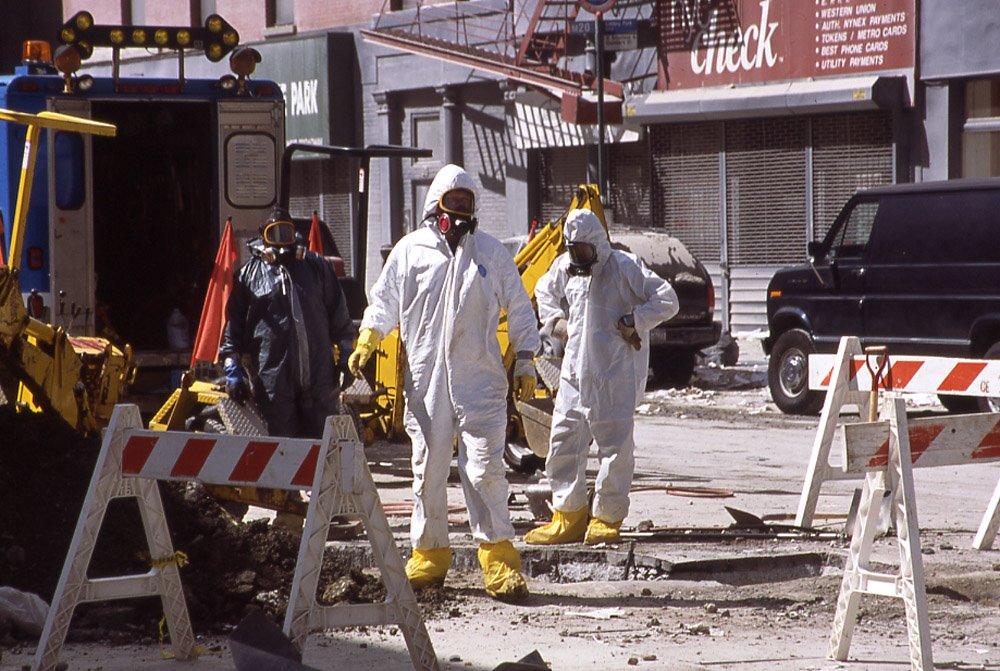
    A big question for residents is how toxic has the waste been? We saw at least 3 "washing stations" where they hosed down cars and workers; one with a truck labeled "Lead & Asbestos Service". The community board promises an "independent" measurement by next week.


    I was excited to have electricity so I could send some email. But every time I logged on to AOL: "If you want Mets Tickets or more information on Ticketron events in the metropolitan area, call 212-955-5000." All over we all got the same message for every downtown phone that didn't work.

    Our neighbors in the building began to turn up. Lionel had set up phone contacts with a couple of them on Tuesday. We all seemed sort of surprised at how glad we were to see each other, and how good it felt that we were all okay. From the school yard some of our kids saw it fall down, and they saw people jumping.

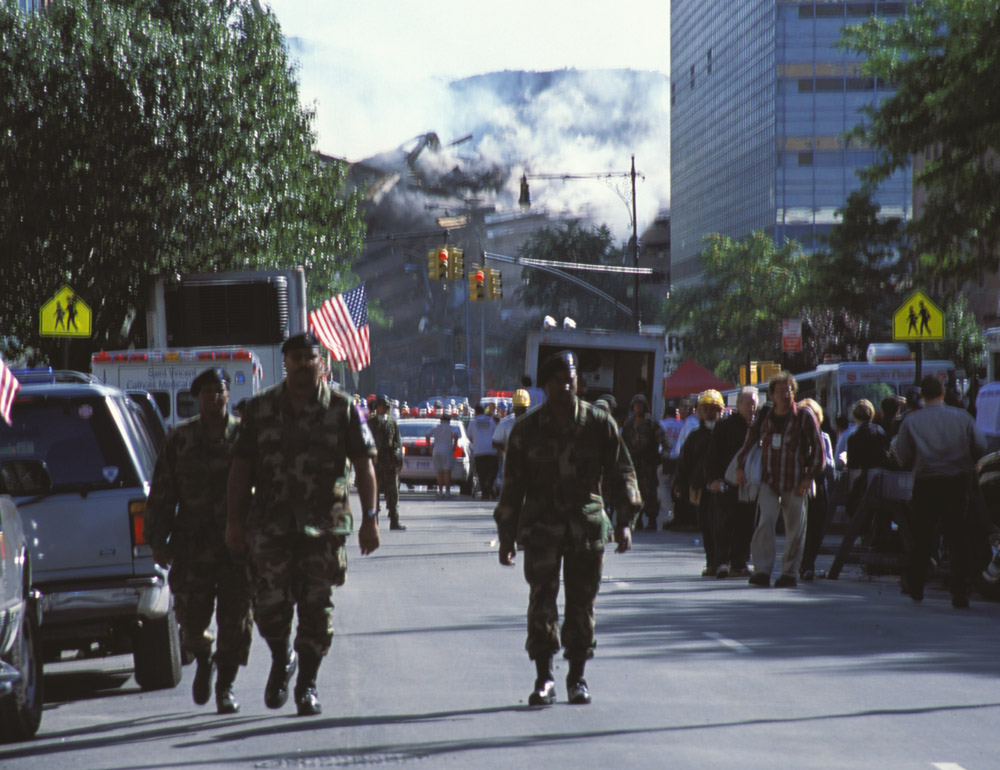
    It is strange to have your neighborhood occupied, to see Humvees ("Hummers" to me but Lionel says that's not accurate) all over the place, to see national guard and police everywhere. To see crews come on duty, all strong, and then go off weary to the bone and the soul. To have rescue tents and stations all over.


    We met state troopers from Syracuse and firemen from Flint, Michigan; we saw one overwhelmed policeman dissolve in sobs. We heard someone in the street telling someone else, in a broad midwest drawl which I can imitate, where Renssalear, Indiana, is, "near Chicago."

    But mostly we just kept out of the way. They didn't need more
    volunteers; and we residents were not part of their emergency (fortunately).

    We stared in shock late on Saturday night when we realized that what we saw at the end of Greenwich Street in front of the 7 WTC rubble was the 15-story WTC antenna, square in the middle of the street, standing straight up. It was gone on Sunday.
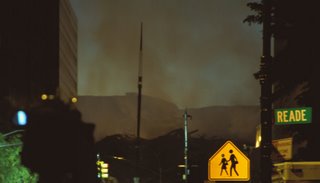

    As we walked around over the weekend we saw mounds and mounds of bottled water
    and packs of water bottles, especially by the rescue tents but all
    over. Workers were giving us water. There were other places where food
    was just dropped and abandoned because generosity had outpaced need.

    By the Borough of Manhattan Community College side steps we found a mound of huge bags of dog food for the canine workers. On Sunday Franklin street was lined with boxes of new T-shirts for anyone who needed them, rescue or local. The Tribeca Tribune editor was wearing one since he hadn't any more clean clothes..

    Saturday was prep day for getting the Stock Market open and Wall Street running. Little trucks were at every corner for Con-Ed, Nextel, Verizon, Sprint etc etc; big trucks rolled by with huge wheels of cable. They were re-knitting communications and laying extra lines on the ground.

    Lots of buildings already had emergency and back up generators. I counted 22 "rented" portable hitch trailer generators lining Leonard Street on Sunday night between Broadway and Church, waiting for some business' power to fail on Monday, waiting for a call for help.

    All week newspapers were in short demand "below the perimeter" ... Mary's Stationery is a little narrow store front on Hudson with a beat up couch, a fine espresso counter, and lots of magazines; it's an adult "hangout." Mary has a British accent and is about 4' x 5'. Sunday, Jason said the papers would be in in 10 minutes. 20 minutes later when I came back he was frantically on the cell phone: "Tell her to come back; I sent 4 customers after her, on bikes!"

    Two minutes later a Con Ed truck pulled up, opened the back doors and there were at least fifty bundles of the Sunday Times. The customers unloaded and Mary showed up, beaming, 5 minutes later. I heard later that all week she had been paying someone "up north" maybe $1 a copy to deliver any copies of the daily papers they could get.


    It was beautiful on Sunday. September in New York City is the best, when "you can see forever" under a brilliant clear blue sky. The winds usually blow from north to south and the air is crystal. If you look north, you can almost believe nothing has changed. But then you see the Empire State Building.

    The black smoke over 7 WTC was turning white Sunday night and thinning out. You could see a ghostly outline of the altered skyline. We'll get used to it; but there will come days now and then when we will forget and be jolted into sorrow when we round the corner.

    The national guard was directing traffic at Worth and Church Streets on
    Sunday night. Traffic was all "official."

    Tomorrow is Monday. The Stock Exchange will be open.


    All rights reserved
    Barbara Fultz Martinez

    Photographs copyright Lionel Martinez

    Monday, July 06, 2009

    World Wide Top 10 Spammers 2009


    This TOP 10 chart of ROKSO-listed spammers is based on those Spamhaus views as the highest threat, the worst of the career spammers causing the most damage on the Internet currently. Spamhaus flags these as a priority for Law Enforcement Agencies.


    1 Canadian Pharmacy United States
    A long time running pharmacy spam operation. Uses botnet spam techniques to send tens-of-millions of spams per day. Probably uses many affiliates all over the world to spam but is probably based in Eastern Europe and hosts sites on botnets and on Chines

    2 Leo Kuvayev / BadCow Russian Federation
    Russian/American spammer. Does "OEM CD" pirated software spam, copy-cat pharmaceuticals, porn spam, porn payment collection, etc. Spams using virus-created botnets and seems to be involved in virus distribution. Partnered with Vlad - aka "Mr. Green"

    3 HerbalKing India
    Massive affilitiate spam program for snakeoil Body Part Enhancement scams. Also does replica luxury goods, pharma and porn. Spams via botnets, bulletproof hosting offshore and even sometimes uses fast flux hosting.

    4 Vincent Chan / yoric.net Hong Kong
    Vincent Chan and his Chinese partners have been sending spam for years. They mainly do pharmacy, and are able to send out huge amounts daily. The use a vast amount of compromised machines, for sending, hosting and proxy hijacking.

    5 Alex Blood / Alexander Mosh / AlekseyB / Alex Polyakov Ukraine
    So many Alex & Alexey spamming! Alex Blood tied to Pilot Holding & bbasafehosting.com long ago, then Alex Polyakov posted he owned them. Massive botnet and child-porn spam ring, also pharma, mortgage, and more. May work with Kuvayev and Yambo.

    6 Nikhil Kumar Pragji / Dark-Mailer Australia
    Through the Dark-Mailer Windows based proxy-botnet based spamware, this spammer is responsible for and behind a large portion of the world's illegally send spam.
    Queensland

    7 Peter Severa / Peter Levashov Russian Federation
    A spamming partner of Alan Ralsky and other spam gangs.

    8 Yambo Financials Ukraine
    Huge spamhaus tied into distribution and billing for child, animal, and incest-porn, pirated software, and pharmaceuticals. Run their own merchant services (credit-card "collection" sites) set up as a fake "bank."

    9 Ruslan Ibragimov / send-safe.com Russian Federation
    Stealth spamware creator. One of the larger criminal spamming operations around. Runs a CGI mailer on machines in Russia and uses hijacked open proxies and virus infected PCs to flood the world with spam.

    10 Rove Digital Estonia
    Botnets, malware, spam, pharming, DDoS. Inhoster, Cernel, Esthost, Atrivo. What else needs to be said?

    Find Out More About Spam:
    http://www.spamhaus.org/


    Spam Sent 40 million
    Click through ratio 0.12%
    Total Click-throughs 48,000
    Click-through-to-sales ratio 1/200
    Total sales 240
    Total sales revenue $37,440.00
    Spammer Commission rate 50% (Gah!)
    Total spammer income $18,720.00
    -------------------------------------------------------------
    Weekly costs
    Bulletproof hosting $230
    4 days of botnet access $6800
    Email addresses $4000
    Total Costs $11,030
    Net Profit $7690


    Or about $350,000 per year

    Sunday, June 28, 2009

    The Speed of Michael Jackson’s Death in the News


    Thursday 6/25 I was working in an independent television studio.


    I was making broadcast masters for a show we regularly video record. There is a certain amount of free time while the masters are being duplicated, so I logged into my twitter account. After a few moments I began reading random tweets and saw one that said "McMahon, Fawcett and now Michael Jackson.

    This was first I became aware that anything had happened to Michael Jackson. A quick glance at Google News had many stories about Michael Jackson being hospitalized for a heart attack. The time was 5:18 pm EDT.

    We in the studio were discussing the possible causes for Jackson’s heart attack when I refreshed the Google page and noticed that the TMZ had announced that Michael Jackson had died. The time at this point was 5:22 pm EDT.

    For the next few minutes as far as google was concerned only TMZ reported on Jackson's death.

    Then websites like Newsday, and a San Antonio newspaper site reported on his death. Moments later the Washington Post was joined the death reports and there now a good chance that this was a true story.


    A quick click to the Washington Post’s website was met with an system error. It seemed they were knocked out by a surge in traffic. The time now was 6:02 pm EDT.

    At this point we fell back on traditional media and turned on the television. Neither CNN, MSNBC, nor Fox had reported on Michael Jackson's death. They were still carrying stories about the heart attack were still waiting for further news.

    It was almost a half hour later the major media announced his death.


    More Internet News Impact Stories:


    Michael Jackson Dies -TMZ
    http://www.tmz.com/2009/06/25/

    How Michael Jackson’s death made search engines go crazy
    http://www.examiner.com/x-10080-DC-EGovernment-Examiner

    Michael Jackson’s death reported in near real time
    http://digital.venturebeat.com/2009/06/25/

    TV misses out as gossip website TMZ reports Michael Jackson's death first
    http://www.latimes.com/news/local/la-me-jackson-media